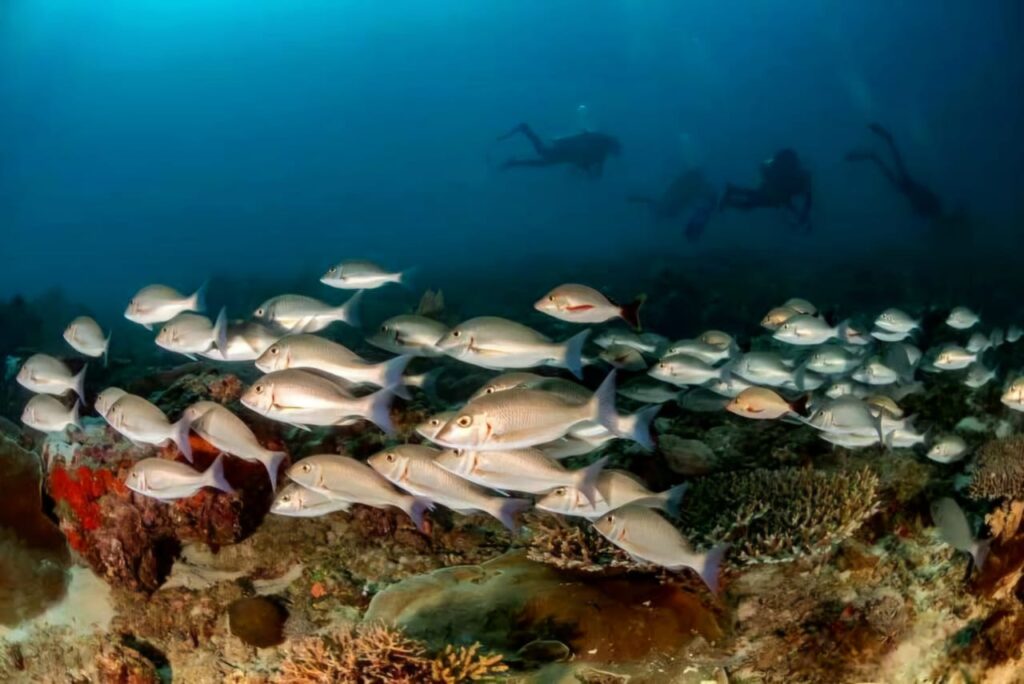
A Complete Guide to the Indian Ocean’s Best-Kept Secret, “Breath Normal As You Continue”.
Zanzibar is famous for its powder-white beaches and spice-scented breezes, but beneath the surface of the Indian Ocean lies an entirely different world-one of coral gardens, drifting reef sharks, and visibility that stretches for tens of meters. Whether you’re a seasoned diver chasing your next logbook entry, a first-timer curious about what lies beneath, or someone drawn to the quiet discipline of free diving, Zanzibar has a way into the water for you.
Why Zanzibar?
Zanzibar sits at the meeting point of warm equatorial currents, which means the waters here stay pleasantly warm year-round, usually between 26°C and 29°C. The archipelago’s position off the Tanzanian coast also puts it close to some of East Africa’s richest marine ecosystems, including protected marine parks around Mnemba Atoll, Tumbatu island and Chumbe Island. Add in healthy coral cover, dramatic drop-offs, and a good chance of encountering dolphins, turtles, and during the right season-whale sharks, and it’s easy to see why divers keep coming back.
Diving for Certified Divers
For those who already hold a certification, Zanzibar rewards a bit of exploration. Mnemba Atoll and Tumbatu are the headline sites: a protected reef famous for its wall dives, swim-throughs, and resident population of green and hawksbill turtles. Currents here can be brisk, which is exactly what draws in the pelagic life reef sharks, eagle rays, and, from roughly October to March, the possibility of whale sharks passing through.
Further afield, Pemba Island (Zanzibar’s quieter northern neighbor) offers some of the most dramatic wall diving in the region, with vertical drop-offs beginning just a few meters from the surface and disappearing into the blue. For wreck enthusiasts, there are a handful of sunken vessels along the coast that have become thriving artificial reefs.
Certified divers can typically expect:
- Two-tank morning dives to the outer reefs and atolls
- Drift dives suited to intermediate and advanced divers
- Night dives on request at select operators
- Excellent visibility, often 15–30 metres depending on season and tides
Diving for Beginners (No Certification Required)
You don’t need a certification card to get in the water here. Most dive centers in Zanzibar offer an introductory or “Discover Scuba Diving” experience a supervised, shallow-water dive with a qualified instructor by your side the entire time. No prior experience is needed, and the format is designed to let first-timers feel the weightlessness of breathing underwater in a calm, controlled setting before deciding whether to pursue a full certification.
A typical introductory session includes a short theory briefing on land, practice with the equipment in shallow water, and then a guided dive along a shallow reef, usually no deeper than 6–12 metres. It’s an ideal way to test the waters, quite literally, before committing to a multi-day course.
Diving Courses You Can Complete in Zanzibar
Zanzibar has become a genuinely good place to get certified, with several PADI and SSI-affiliated dive centres offering the full spectrum of courses:
- Open Water Diver: the entry-level certification, typically taking 3–4 days and combining classroom theory, confined water practice, and four open-water dives. This is the course most first-time divers take to become independently certified.
- Advanced Open Water Diver: for certified divers looking to build skills and depth range, usually completed over 2–3 days with five adventure dives (often including deep and navigation dives).
- Rescue Diver: a more intensive course focused on self-rescue and diver-assistance skills, valuable for anyone planning to dive regularly.
- Specialty courses: options such as Night Diver, Wreck Diver, and Peak Performance Buoyancy are commonly available depending on the operator.
- Divemaster and instructor-track courses: for those considering diving professionally, several centers in Zanzibar also offer professional-level training.
Courses are generally taught in small groups with a strong emphasis on safety, and many operators offer flexible scheduling to fit around the rest of a holiday itinerary.
Free Diving
For those drawn to a quieter, more meditative way of experiencing the ocean, Zanzibar is also an excellent place to try free diving. Unlike scuba diving, free diving relies on a single breath-no tanks, no bubbles, just the diver, the breath-hold, and the reef. The clear, warm waters and gentle conditions around Zanzibar’s atolls make it a forgiving environment for beginners to learn proper breathing techniques, equalization, and relaxed descents under the guidance of a certified free-diving instructor.
Beginner free-diving courses typically start with breath-hold theory and static apnea practice at the surface before progressing to shallow, guided dives along the reef. For experienced free divers, the atolls’ walls and drop-offs offer the kind of depth and visibility that make for genuinely memorable dives a chance to glide silently past coral formations and marine life without the noise of a regulator.
Whether you’re strapping on a tank for the first time, ticking off an advanced certification, or simply holding your breath and sinking into the silence, Zanzibar’s waters have a place for every kind of diver.
Who We Work With
To make sure every guest gets a safe, professional experience in the water, we partner with trusted local specialists for each activity:
- TGI Diving Center: certified scuba diving trips and PADI course instruction
- Dive Point: introductory dives and full certification courses in small groups
- One Ocean: guided reef and atoll dives for beginner and advanced divers
- Mermaid Experience: our dedicated free diving partner, offering breath-hold training and guided sessions
Every dive and course booked through Tanzanite Signature Safaris is delivered in partnership with these trusted operators.
Zanzibar Snorkeling, Diving & Free Diving: FAQ
Snorkeling
Do I need any experience to snorkel in Zanzibar? No. Snorkeling requires no certification or prior experience. A short briefing on using the mask, snorkel, and fins is all that’s needed before heading out.
Where are the best snorkeling spots? Mnemba Atoll and the Nakupenda Sandbank are the most popular, offering shallow reefs, calm water, and abundant marine life. Both are suitable for all ages and swimming abilities.
Can non-swimmers snorkel? Yes, with a life jacket and close guide supervision. Most operators can accommodate weak or non-swimmers on request.
What will I see? Tropical colorful reef fish, sea turtles, coral gardens, and occasionally dolphins. Visibility is usually excellent year-round.
Is snorkeling safe for children? Yes, it’s one of the most family-friendly ocean activities available, typically suitable from around age 6 upward with a life jacket.
What’s the best time of day or season? Morning trips generally offer calmer water and better visibility. The driest months (June–October, December–February) tend to have the clearest conditions overall.
Scuba Diving
Do I need a certification to dive? No, first-timers can join a supervised introductory dive (“Discover Scuba Diving”) with an instructor, no certification required. Certified divers can join standard dive trips at their level.
How deep and how long are the dives? Introductory dives are shallow, usually 6–12 metres. Certified dives vary by site and certification level, generally ranging from 12–30 metres, with dive times of 40–60 minutes.
What certifications can I get in Zanzibar? Open Water, Advanced Open Water, Rescue Diver, various specialty courses (Night, Wreck, Buoyancy), and professional-level courses such as Divemaster are all available through PADI/SSI-affiliated centres.
How long does the Open Water course take? Typically 3-4 days, combining theory, confined water skills, and four open-water dives.
Is prior swimming ability required? Yes, basic swimming comfort is required for certification courses, though introductory dives can accommodate more limited swimmers with extra support.
What marine life can I expect to see while diving? Tropical fish, turtles, reef sharks, eagle rays, colorful reef fish, and seasonally (roughly October–March) whale sharks around the outer atolls but is not guaranteed.
Is Zanzibar diving suitable for beginners as well as experienced divers? Yes. Shallow reef sites suit beginners and course students, while Mnemba Atoll’s drift dives and Pemba Island’s wall dives offer more challenge for advanced divers.
Do I need my own equipment? No, you can rent full equipment at a diving center and for the courses are already included in the packages. For the fun divers you can have your own equipment so as to reduce costs.
Free Diving
What is free diving, and how is it different from scuba diving? Free diving is done on a single breath-hold, without tanks or breathing equipment. It focuses on breathing technique, relaxation, and controlled descents rather than air supply.
Do I need experience to try free diving? No. Beginner courses start with breathing theory and static breath-hold practice at the surface before progressing to shallow, guided dives.
Is free diving safe for beginners? Yes, when taught by a certified free-diving instructor and practiced within recommended limits. Courses are structured to build skills gradually and safely.
How deep can beginners go? Beginner sessions are typically shallow and guided, focusing on comfort and technique rather than depth. Depth increases naturally with training and experience.
Can I combine free diving with a snorkeling or scuba trip? Most operators offer free diving as a separate, dedicated course or session rather than combining it with scuba dives, since the techniques and pacing differ.
Why try free diving in Zanzibar specifically? The warm, clear, and calm waters around the atolls make it an ideal, low-stress environment for learning breath-hold techniques and enjoying the reef in near silence.