Every year, in an ancient rhythm that has played out for millennia, over 1.5 million wildebeest — accompanied by hundreds of thousands of zebra and gazelle — undertake one of the most breathtaking journeys on earth. The Great Migration is not a single event but a continuous, year-round cycle driven by one simple force: the search for fresh grass and water across the Serengeti-Mara ecosystem.
The Route
The migration moves in a broad clockwise loop between Tanzania’s Serengeti National Park and Kenya’s Maasai Mara National Reserve — a circuit covering roughly 1,800 kilometres. There is no beginning and no end. The herds are always moving, always following the rains.
In the southern Serengeti and Ngorongoro Conservation Area, the short-grass plains fill with life between December and March. This is calving season — over 8,000 calves born every single day at peak, a spectacle of raw, overwhelming abundance. Predators gather. The plains hum.
By April and May the long rains arrive and the herds begin drifting northwest, through the central Seronera valley and into the western corridor. June brings them to the Grumeti River — the first of two legendary crossings, where massive Nile crocodiles have waited all year for this single moment.
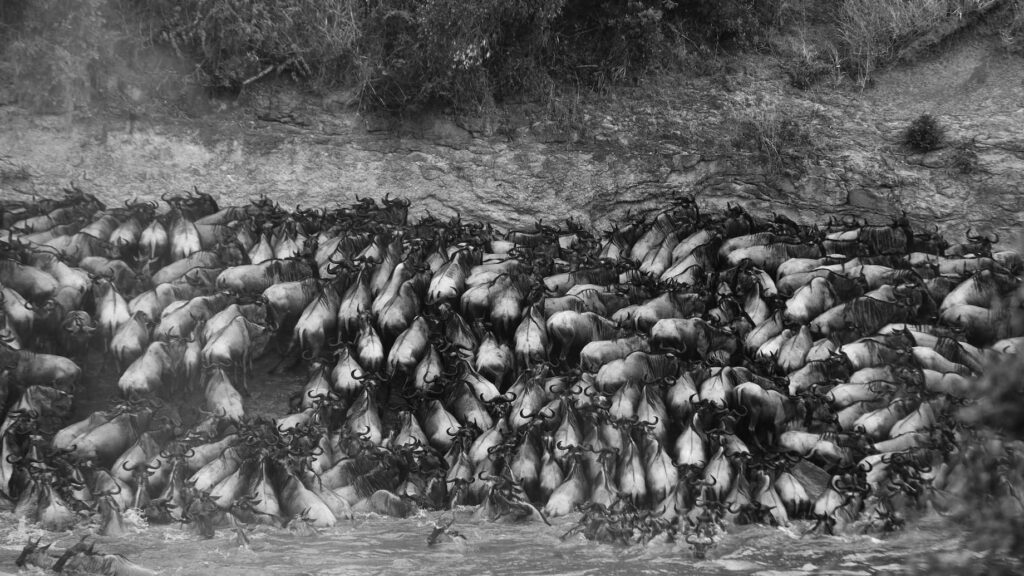
By July and August the herds push north into the Maasai Mara. This is when the Mara River crossings happen — the images you have seen on every wildlife documentary, the ones that stop your breath. Thousands of animals hurling themselves into churning water, scrambling up muddy banks, the air thick with dust and noise and the particular chaos of survival.
By October the short rains return and the herds turn south again, back into the Serengeti, back toward the calving grounds. And the cycle begins again.
The River Crossings
Nothing in the natural world quite prepares you for a river crossing. The herds gather on the bank for hours — sometimes days — pacing, retreating, surging forward. Then something shifts. One animal commits. The rest follow in a thundering cascade.
The Mara River is narrow but deceptive. The current is strong, the banks are steep and slick, and in the deep pools below the crossings, crocodiles that can exceed five metres in length hold absolutely still. The wildebeest know what waits. They cross anyway. That tension — instinct versus survival, the mathematics of risk played out in real time — is what makes a crossing one of the most emotionally affecting things a human being can witness in the wild.
No two crossings are the same. Some are over in minutes. Others take hours. Some days the herds turn back entirely. You cannot book a crossing. You cannot guarantee one. That is precisely the point.
When to Go
The migration is present somewhere in the ecosystem all year, but the timing of your visit determines what you experience.
January – March is calving season in the southern Serengeti. The plains around Ndutu are dense with newborns and the predators — lion, cheetah, hyena, wild dog — that follow them. It is arguably the most dramatic predator-prey dynamic of the entire year, and far fewer visitors make it here than to the Mara crossings.
June – July brings the western corridor and the Grumeti crossings. Less visited than the Mara, rawer, with enormous crocodiles and the added drama of the river forest landscape.
July – October is Mara River crossing season. This is peak season — the most sought-after window, and for good reason. The crossings can happen daily in a good year, and the concentration of wildlife on both sides of the river is extraordinary.
November – December sees the herds moving south again through the eastern Serengeti. Quieter, more contemplative, with long golden light and far fewer vehicles.
Where to Stay
Your camp location matters enormously. The migration moves, and a camp that is perfectly positioned in August may be hours from the action in September. A good operator — one who knows the ecosystem intimately — will place you in the right place at the right time, moving you if necessary.
In the southern Serengeti, the mobile camps around Ndutu track the herds through calving season. In the western corridor, intimate tented camps along the Grumeti River offer exclusivity and proximity few visitors experience. In the Mara, the best camps sit on private conservancies bordering the reserve — more land, fewer vehicles, better game viewing, and the kind of silence that reminds you where you actually are.
Beyond the Numbers
It is easy to reduce the Great Migration to statistics — 1.5 million wildebeest, 500,000 zebra, 8,000 calves per day — and lose sight of what it actually feels like to be there.
It feels like standing at the edge of something ancient. The ground vibrates. The dust rises in columns you can see from kilometres away. The sound — hooves, snorts, the low collective rumble of a herd in motion — is something closer to weather than to animal noise.
The wildebeest are not beautiful in the conventional sense. They are ungainly, wide-faced, perpetually bewildered-looking. But watching half a million of them move across an open plain at dusk, the light going gold and then amber and then gone, you understand something about this planet that no photograph has ever quite managed to convey.
The Great Migration is not an event you watch. It is something that happens around you, and to you, if you let it.
Ready to witness the Great Migration for yourself? Speak with a Tanzanite Safaris specialist and we will build your journey around the precise window — and the precise location — that matches what you are looking for.